
Inside the Making of a Reliable Smart Driver: A Manufacturer’s Perspective

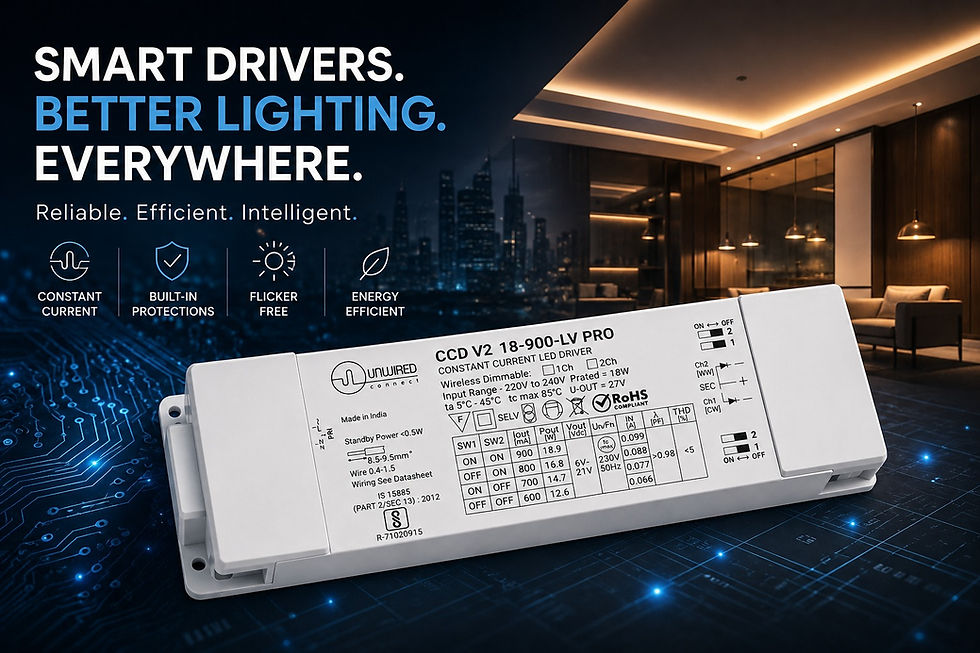
When a smart lighting project performs flawlessly, nobody notices the driver.
When it doesn't, everyone does.
Flickering lights, communication failures, delayed responses, and inconsistent dimming are often blamed on installation or software. In reality, many of these issues originate much earlier—in the way the driver was designed, engineered, tested, and manufactured.
At Unwired Connect, we believe a reliable smart driver is not just a product. It is the outcome of a carefully managed lifecycle that begins long before the first unit leaves the factory.
Step 1: R&D – Designing for Real-World Indian Conditions
Where will this product actually operate, and what challenges will it face every day?
At Unwired Connect, our R&D approach goes beyond understanding the application—whether it is a commercial office, retail showroom, hospitality project, or industrial facility.
We also design for the operating environment.
This becomes extremely important in India, where electrical conditions can be very different from controlled global environments. Voltage fluctuations, power instability, surge conditions, and varying installation practices can significantly impact product reliability.
A driver that performs well in laboratory conditions may not necessarily survive demanding field conditions.
This is where engineering depth matters.
Unlike many low-cost imported products designed for generic global use cases, UWC smart drivers are engineered considering Indian electrical realities. Critical aspects such as surge protection, power stability, thermal performance, and long-term durability are evaluated during the design stage itself.
Our objective is simple:
Don't just build products that work on day one.
Build products that continue working reliably for years.
Step 2: Firmware – The Intelligence Behind the Hardware
Hardware provides the foundation, but firmware determines how intelligently the driver behaves.
Firmware controls communication, dimming performance, scene execution, fault handling, and device responsiveness. Poor firmware can lead to flickering, delayed commands, or unstable networks.
That's why our engineering teams continuously develop, test, and refine firmware to ensure smooth operation across different lighting control environments.
Step 3: PCB Design & Component Selection
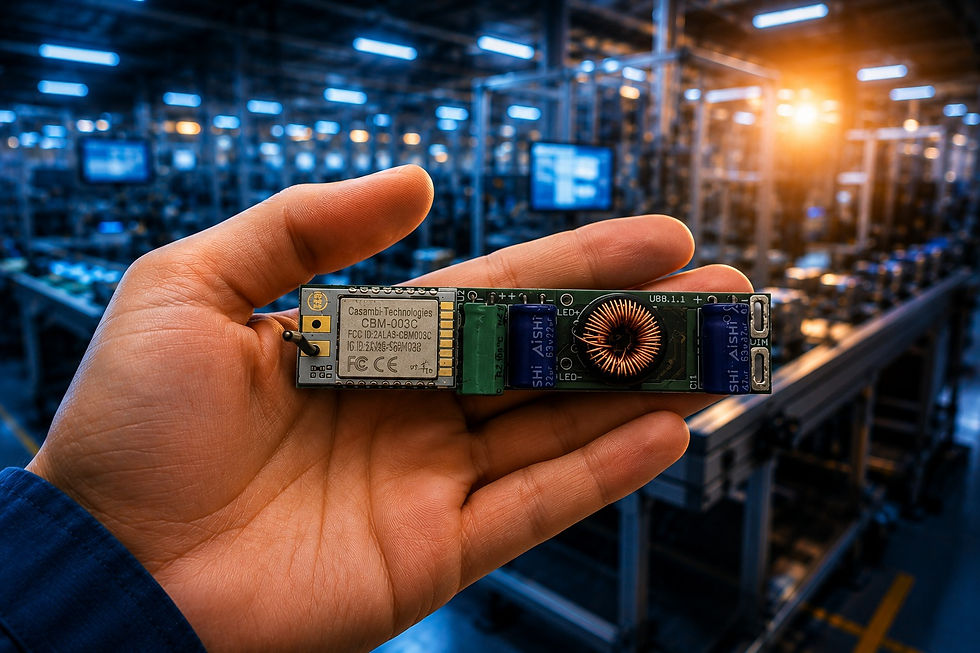
Two drivers may look identical from the outside but perform very differently over time.
The difference often lies in the PCB design and the quality of components used internally.
Careful attention to thermal management, signal integrity, power protection, and component reliability helps ensure stable operation even under demanding conditions.
For us, reliability starts at the component level.
Step 4: Testing Before Production
Before a product reaches customers, it must prove itself.
Every design undergoes multiple rounds of validation, including:
Functional testing
Thermal testing
Communication testing
Load testing
Electrical stress testing
The objective is simple: identify potential failures before they reach the field.
A specification sheet may tell you what a driver is designed to do. Testing reveals how reliably it will continue doing it.
Step 5: Manufacturing & Quality Control
Even the best design can fail without manufacturing consistency.
That's why quality checks are built into every stage of production—from incoming component inspection to final product testing.
This ensures that every unit leaving the factory meets the same standards as the prototype that was originally approved.
Consistency is what transforms a good product into a dependable one.
Step 6: Field Validation & Continuous Improvement
The journey doesn't end after production.
Real-world deployments provide valuable insights that help improve future product generations. Feedback from system integrators, installers, and end users helps refine both hardware and firmware over time.
This continuous improvement cycle is one of the key advantages of working with a manufacturer that owns its technology stack.
Why Manufacturing Matters
Many companies sell smart lighting products. Fewer actually design and manufacture them.
A manufacturer controls the entire lifecycle—from R&D and firmware development to testing and quality assurance. This enables faster troubleshooting, product customization, firmware enhancements, and long-term support.
When technology is developed in-house, reliability becomes a process—not a promise.
Reliability Is Engineered, Not Promised
A reliable smart driver is not created by assembling components together.
It is the result of hundreds of engineering decisions across R&D, firmware development, PCB design, component selection, testing, manufacturing, and field validation.
At Unwired Connect, every stage of this lifecycle is controlled with a single objective—delivering products that perform consistently in real-world conditions.
This engineering-first approach has helped us achieve exceptional field reliability with virtually zero product failures across deployments.
Because when smart lighting becomes part of critical infrastructure, reliability cannot be an afterthought.
It has to be built into the product from day one.




Comments