
Why India Needs Domestic OEMs for Smart Lighting, Not Just Importers

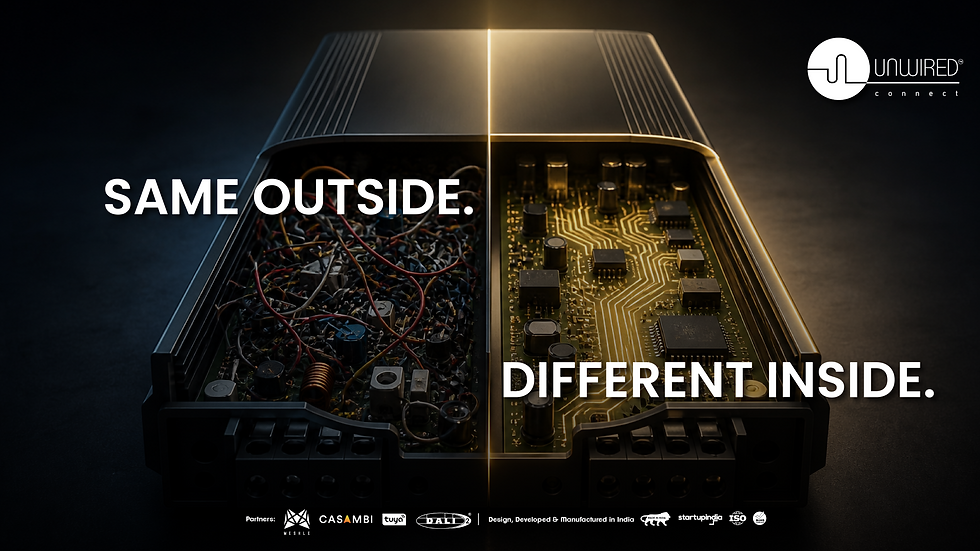
Rethinking the Future of Smart Controls in an Import-Dependent Ecosystem
India Is Building Smart Infrastructure—But Not Always with Hardware It Controls
India today is one of the fastest-growing markets for smart infrastructure. From commercial offices and retail chains to factories and smart homes, lighting controls are becoming a core layer of digital infrastructure.
Yet, behind this growth lies a structural imbalance:
India consumes smart lighting hardware at scale—but still depends heavily on imported control systems.
Most of what powers “smart” lighting today—drivers, sensors, gateways—comes from external ecosystems, often through traders and importers.
On the surface, this works. At scale, it creates long-term challenges.
Because smart controls are not just components. They are infrastructure that must perform consistently over the years, across sites, and under real-world conditions.
And that requires something India cannot import indefinitely: manufacturing ownership.
Two Models, Two Outcomes: Importers vs Domestic OEMs
To understand the shift India needs, it’s important to distinguish between two fundamentally different models.
The Importer / Trader Model
Imports finished hardware from overseas OEMs
Limited or no control over design and firmware
Dependent on external supply chains
Price-driven procurement
Minimal lifecycle accountability
The Domestic OEM Model
Designs and manufactures products locally
Owns firmware, electronics, and product roadmap
Controls quality, testing, and batch consistency
Supports long-term product lifecycle
Enables customization and evolution
This is not just a difference in sourcing—it’s a difference in capability, control, and long-term reliability.
Economic Impact: From Consumption to Value Creation
India’s dependence on imported smart hardware has broader economic implications.
What the Import Model Leads To
Continuous outflow of foreign exchange
Limited domestic value addition
Minimal local R&D investment
Weak manufacturing ecosystem
What Domestic OEMs Enable
Retention of economic value within India
Job creation across R&D, production, and support
Development of local engineering expertise
Strengthening of India’s electronics ecosystem
Importing builds consumption.Manufacturing builds capability.
As India moves toward becoming a global manufacturing hub under initiatives like Make in India and benefits from trade agreements like the India-EU FTA, domestic OEMs will play a critical role in turning India from a market into a producer.
Operational Reality: Where Importers Fall Short

The real limitations of an import-driven ecosystem become visible only during execution and operations.
Across projects, integrators and consultants routinely face:
Inconsistent Hardware Behaviour
Same product, different batch → different performance
Dimming curves vary
Sensors behave unpredictably
Control logic changes subtly
Firmware Dependency
No ownership of firmware
No ability to fix bugs quickly
No guarantee of backward compatibility
Unpredictable Supply Chains
Delays due to imports and logistics
SKU changes without notice
Difficulty in scaling multi-site deployments
No Repairability
Devices are replaced, not repaired
Root causes remain unidentified
Lifecycle costs increase over time
Limited Accountability
When issues arise:
Traders depend on upstream OEMs
Resolution timelines are unclear
On-ground teams absorb the impact
This is where the key distinction emerges:
Lighting fixtures can be replaced. Controls must be reliable.
And reliability cannot be outsourced.
Sustainability & the Right to Repair: A Growing Imperative
Sustainability in IoT and smart infrastructure is no longer optional—it’s becoming a regulatory and business requirement.
The current import-heavy model often leads to:
Short product lifecycles
High electronic waste
Limited serviceability
No repair ecosystem
This directly contradicts emerging frameworks like:
India’s Right to Repair initiative
ESG compliance expectations
Circular economy goals
Domestic OEMs Enable Sustainable Systems
Repairable hardware design
Local servicing capabilities
Longer product lifecycles
Reduced e-waste
Sustainability isn’t just about energy savings. It’s about how long your hardware lasts—and whether it can be repaired.
Technology & Innovation: Who Builds the Future?
In smart lighting, innovation doesn’t come from assembling products—it comes from owning the technology stack.
Limitations of Import-Driven Innovation
Feature roadmap controlled externally
Slow adaptation to local needs
Limited customization
Reactive, not proactive development
Advantages of Domestic OEM Innovation
Firmware ownership → faster iteration
Ability to design for Indian conditions:
Voltage fluctuations
Temperature extremes
Usage intensity
Multi-protocol capability:
BLE Mesh
Zigbee
Platform ecosystems like Casambi, Tuya, etc.
Importers follow trends.OEMs create them.
The Emerging Role of Companies Like Unwired Connect
A new generation of Indian companies is beginning to bridge this gap.
Companies like Unwired Connect (UWC) represent a shift from:
importing smart hardware → building smart control ecosystems
With:
In-house R&D
Firmware ownership
Electronics and PCB design
Protocol-agnostic manufacturing across platforms
Focus on consistency and reliability
These companies are not just suppliers—they are enablers of a more robust, scalable smart infrastructure ecosystem in India.
Conclusion: India Doesn’t Just Need Smart Systems—It Needs to Build Them
Smart lighting controls are no longer optional add-ons. They are the core infrastructure for modern buildings.
Relying on imported, opaque systems may work in the short term. But long-term reliability, scalability, and sustainability demand a different approach.
India doesn’t just need to install smart systems. It needs to design, build, and own them.
The transition from importers to domestic OEMs is not just an industry shift—it is a strategic necessity.
Because the future of smart infrastructure will not be defined by who installs it, but by who builds it.


Comments